The Scylla of violence
http://thenews.com.pk/daily_detail.asp?id=237757
The News
Thursday, May 06, 2010
Dr Mohammad Taqi
"This is a political war and it calls for discrimination in killing." -- John Paul Vann, US adviser in Vietnam
The recent killing of Professor Nazima Talib in Quetta has once again called into question the logic of indiscriminate violence against the non-combatant, non-Baloch settlers in the province. It has turned the focus of attention not only to the Baloch guerrilla fighters but has simultaneously put those, who support a non-violent Baloch struggle, on the spot.
Writing about the potential US policy towards Balochistan, Selig S. Harrison noted in his 1981 book 'In Afghanistan's Shadow' that, "with respect to the Baloch issue, the American goal should be to forestall the necessity for a choice between the Scylla of supporting repressive counterinsurgency programs and the Charybdis of supporting Baloch independence."
Indeed both the friends and foes of the Baloch have had to follow this impossible-to-negotiate path. The state players like the USA, former Soviet Union and India have erred - by design or default - in favour of the Pakistani state, while treading this regional policy tightrope.
For the individual and politically or apolitically organised supporters, sympathisers and fellow-travellers of the Baloch struggle, it has been a rather straightforward matter where they have consistently condemned the repressive tactics of the Pakistani state machinery while openly endorsing the Baloch cause. Be it the joining of the 'London Group' boys with the Parari (fighters) in Marri hills in the1970s or lending open - albeit tepid - political support from Wali Khan to Asif Zardari, the Baloch struggle has had almost unanimous backing from the leftist and the centre-left circles of Pakistan.
With the rising spate of killings of the non-combatants, especially Punjabis, in Balochistan, the non-Baloch sympathisers of the Baloch nationalists are finding themselves in an increasingly difficult situation in defending what they have held to be a legitimate resistance and indeed a just war.
The nature of the Baloch guerrilla struggle has been complex throughout its many phases. For the most part though, it has followed - as accurately noted by Selig Harrison - the line given by Che Guevara's associate Régis Debray: in the revolutionary struggle the fighters themselves should be the focus of political power and not subservient to the political leadership not involved in fighting.
Sardar Ataullah Mengal and to some extent Nawab Khair Bukhsh Marri had correctly observed during the 1970s that the students and non-students joining the ranks of the armed struggle would not be under their political guidance or control. These leaders, due to both personal and ideological discipline, did not encourage ideological waywardness in the Baloch guerrillas.
On the other hand, the late Nawab Akbar Khan Bugti, for various reasons, contributed to strengthening of this behaviour in the movement. Nawab Bugti was a rather late convert to the Baloch nationalist cause. Besides having a death wish characteristic of a convert, he injected traits in the struggle that have over the last several years contributed to its negative image.
Irregular and asymmetric wars - like any other armed conflict - exhibit tremendous variation in the magnitude and type of violence, even within different phases and time-periods of that particular conflict. The motives of such violence, especially against civilians are complex and multiple. They could range from drawing attention through a spectacular act like the WTC bombings to instilling fear and triggering displacement, as in the case of the Jewish Irgun's attack on Deir Yassin in Palestine.
Regardless of the targets and tactics of violence, it is neither indiscriminate as such nor without consequence. Usually, a method exists to such madness, whether it is a so-called reprisal based on a presumed guilt by association of the target or simply an attempt to plunder and eliminate a group.
More importantly, there are limits to any strategic gains through such violence. Beyond a certain point, violence - indiscriminate or not - is counterproductive. The general population, angered and frightened by the violence, is not only likely to support the state's repressive response but might also resort to tit-for-tat hostilities as have been witnessed in the case of the Baloch students in Punjab.
The Baloch nationalist movement now has reached a juncture where it may lose the support of its various sympathisers in the rest of the country. Similarly, the state apparatus is also at the threshold where it would likely respond by high-profile deterrent activity against the resistance.
The state forces already outnumber and out-gun the Baloch nationalists and have no intention to scale back their repressive activity. Given the geopolitical realities surrounding Balochistan, it is highly unlikely that the Baloch guerrillas will parade down the city streets, mobilise a mass following or engage the state forces in open combat.
With the US, Pakistan and India arriving at a tacit understanding on the future direction of events in Afghanistan, the Baloch question is nowhere near the top of any regional or global power's to-do list.
It is high time that the Baloch fighters and non-combatant elders and leaders revisited the tactics, direction and objectives of their campaign. The traditional Baloch leadership should be brought back into the picture. The Baloch resistance is at a point where, without political leadership, the Scylla of its own violence is about to push it into the arms of the Charybdis of failure.
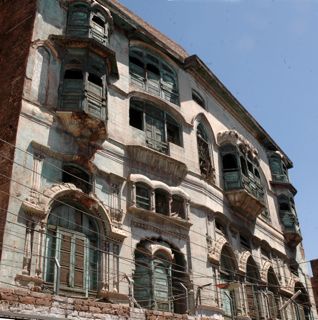
Qissa Khwani قصہ خوانی : In Persian Qissa Khwani means story-telling. Legend has it that the story-tellers used to gather in the ancient Qissa Khwani bazar of Peshawar. The tales here focus on that region but may not be as romantic as those of yore.
Wednesday, May 5, 2010

Sunday, May 2, 2010
Misfortunes of the Left
http://www.dailytimes.com.pk/print.asp?page=2010\05\03\story_3-5-2010_pg3_5
Misfortunes of the Left: Nausée, Ennui and Déluge
By Dr. Mohammad Taqi
March 3, 2010
“ With the development of interest-bearing capital and the credit system, all capital seems to double itself, and sometimes treble itself, by the various modes in which the same capital, or perhaps even the same claim on a debt, appears in different forms in different hands. The greater portion of this "money-capital" is purely fictitious.”
- Das Kapital: Volume 3, Chapter 2 ‘Component Parts of Bank Capital’
My first response to the Daily Times (DT) editorial, “Left Fortunes” dated April 26,2010 was, in the words of Ghalib:
Torr baithay jabkeh hum jaam o suboo, phir hum ko kia
AsmaaN se baada-e-gulfaam go barsa karay
It roughly translates into an unattributed ancient Greek verse:
When I die, let earth and fire mix
It matters not to me, for my affairs will be unaffected
The next day I saw Senator Carl Levin of Michigan on television, ripping apart the top executives of the Goldman Sachs for their continued swindling of our assets. I thought then, that the DT’s call to whip the Pakistani Left - or its leftovers- into shaping up, merits some introspection.
Most important aspect in the editorial was the quote from Karl Marx (Capital Volume 1) which -had it been produced in full - would have answered the editor’s question. Marx said:
"In every stockjobbing swindle everyone knows that some time or other the crash must come, but every one hopes that it may fall on the head of his neighbour, after he himself has caught the shower of gold and placed it in safety. Après moi le déluge! is the watchword of every capitalist and of every capitalist nation. Hence Capital is reckless of the health or length of life of the laborer, unless under compulsion from society."
Having lived in Michigan for ten years as Carl Levin’s constituent, I can safely say that he is no revolutionary. He was acting under a compulsion from the society – a compulsion to take to task the swindlers of the Wall Street, even if for cosmetic reasons alone.
The Pakistani urban voters, who are Islamized enough to don a beard or hijab but smart enough to send their kids to private schools and put their faith in the laissez-faire religion, have not yet created a compulsion for the reckless neo-liberal market economy to mend its ways.
In fact the Pakistani Neocon media, led by the Hamid Mirs and Talat Hussains, have stoked this urban Pak-nationalist zealotry – whose detonator is Saudi Islam- and helped the grotesque fascist mediocrities like the Brothers Sharif, complete their choke-hold on Pakistan’s political economy.
One is tempted to say to Shahbaz Sharif, whose quote “where have those left-wing revolutionaries gone”, the DT had used to start building its case, that:
Muzhdah-i-baad ahle riya raa keh ze maidaaN raftam
(Translation: Greetings to the hypocrites like you, for you have vanquished me and the battlefield is now open to your ilk)
Isn’t this what they, their military patrons and the media Neocons wanted in the first place? Why the gimmickry and the periodic butchering of Habib Jalib’s poetry?
I do not intend to absolve the Left of the blame but it is not correct that the leftist movement in Pakistan died ten years before the fall of the USSR. The closest we came to an openly Marxist party contesting the elections was in 1990, when the Qaumi Inquilabi Party (QIP) of Afrasiab Khattak and Lateef Afridi went to the polls, in alliance with Benazir Bhutto’s PPP. As someone who had the QIP’s manifesto typeset, proofread and printed, I would say that insofar as the Pashtun Left goes, that perhaps was our swan song.
In the Pukhtunkhwa at least, the leftists were tightly allied to the Afghan Left, which outlived the Soviet Union by a year. But this is neither a consolation nor an excuse for our failure as a movement.
The causes of our failure are multiple and complex. Personal rivalries and internecine warfare, blind following of Peking or Moscow, lazy anti-capitalist sloganeering and above all the failure to analyze the class dynamics in the perspective of a multiethnic, tribal-feudal, national security state just about sum-up our shortcomings.
However, the fatal flaws of the Pakistani Left in general and the international leftists in particular are twofold: Firstly, a robust communication system to reach out to those, who need to hear us. Second is the failure, on economic front, to produce a viable alternative model in the post-Soviet era.
In Pakistan’s case, since the government takeover of Mian Iftikharuddin’s Progressive Papers Limited (Pakistan Times and Imroze), we have never been able to find or found a mass publication system. Mazhar Ali Khan’s ‘Viewpoint’, Hussain Naqi’s ‘Sajjan’, Baacha Khan’s ‘Shahbaz’ or even Hanif Ramay’s ‘Musawat’ were no match for the steady might of the State propaganda machinery.
Even today when the US publishing houses are opening shop in Pakistan through the Express Tribune and Newsweek, there is no alternative on the horizon. Marx, Engels and Lenin took pride in prolific writing, whether journalistic, books or pamphleteering. As we say in Medicine, if it hasn’t been documented, it hasn’t happened. The leftists certainly aren’t documenting well. At the very best we are indulging in parallel play and talking past each other.
Had we been communicating with each other, it was hard not to predict the stock market crash of September 2008. The Wall Street subsequently came up with terms like toxic assets and collateralized debt obligations (CDOs) to explain as to what went wrong.
The CDOs were nothing but imaginary money. What led to the US housing-market collapse is one phrase in the opening quote of this article – fictitious capital! Yes, Marx got it right.
If the market economies had to look all the way back to John Maynard Keynes, to find a fix for the recession, there is nothing wrong in revisiting the Marxist economics to look for an alternative, as the DT editorial suggests. It is about time we got over our nausea and ennui and set forth on what Sartre called the roads to freedom.
However, without a robust focus on the economy and mass communications, we won’t be able to invoke a compulsion from the society and might end up plunging into a bigger déluge than we are in.
PS: On a personal note, I want to tender an unconditional apology for any atrocity or abuse of human rights ever committed in the name of Marxist ideology. Fortunately, the Pakistani Left has never been a party to any such act.
(Author practices and teaches Medicine at the University of Florida and contributes to think-tanks www.politact.com & Aryana Institute. Email: mazdaki@me.com )
Tuesday, April 13, 2010
Media, medics and medical errors
COMMENT: Media, medics and medical errors
—Dr Mohammad Taqi
Daily Times
Tuesday, April 13, 2010
http://www.dailytimes.com.pk/default.asp?page=2010\04\13\story_13-4-2010_pg3_6
There is no doubt that the news media has the power to mould society’s perceptions of healthcare issues, including medical errors and negligence. But turning patients into public curiosity, misery into headlines and public shaming of the doctors to the point of coercion, cannot achieve this
“Mistakes live in the neighbourhood of truth and therefore delude us” — Rabindranath Tagore in Fireflies.
What transpired recently between the media-men and doctors at Lahore’s Jinnah Hospital is an ugly blemish that would require a robust and sustained societal action to be washed away. Two groups of professionals were literally at each others’ throats, shredding in the process their respective codes of ethics.
As I watched this brawl on a Pakistani television channel during my lunch hour, I happened to have a medical student with me. As the son of a working journalist, a freelance op-ed contributor and a practicing physician myself, I found myself torn and humiliated when my student asked what was going on. All I could mumble was that some of us like to play above the rules.
My mind then turned to the late CP Scott’s golden rule for newsgathering that “a newspaper’s primary office is the gathering of news. At the peril of its soul it must see that the supply is not tainted.”
Well, could the newsmen on the Jinnah Hospital beat then safely say that the information they gathered was not tainted? Not tainted by the breach of editorial code that any media outlet worth its salt should have in place?
CP Scott’s The Guardian clearly states in its editorial code regarding hospitals that: i) Journalists must identify themselves and obtain permission from a responsible executive before entering non-public areas of hospitals or similar institutions to pursue enquiries. ii) The restrictions on intruding into privacy are particularly relevant to enquiries about individuals in hospitals or similar institutions.
The Guardian’s code also cautions against use of clandestine devices and subterfuge, stating that:
i) The press must not seek to obtain or publish material acquired by using hidden cameras or clandestine listening devices; or by intercepting private or mobile telephone calls, messages or e-mails; or by the unauthorised removal of documents or photographs. ii) Engaging in misrepresentation or subterfuge, can generally be justified only in the public interest and then only when the material cannot be obtained by other means.
All readily available references on professional ethics in journalism emphasise the respect for privacy and human dignity as an integral part of the professional standards of a journalist.
From what has appeared in the media, it is difficult to say if any of the journalists involved would be able to vouch that their reporting in this case was not tainted. There is no doubt that the news media — especially the electronic media — has the power to mould society’s perceptions of healthcare issues, including medical errors and negligence. But turning patients into public curiosity, misery into headlines and public shaming of the doctors to the point of coercion, cannot achieve this.
When the late Aziz Siddiqui pioneered The Frontier Post from Peshawar, he made copies of ‘The Times Style Guide’ and made an ethics code available to the members of his team. A generation later, we have taken a step back to the Tehlka.com mode of sensationalism. We are about to let the mistakes living in the neighbourhood of the truth delude us.
The spat of violence against the doctors, booking them under section 302 of the Pakistan Penal Code, slapping anti-terrorism charges against them under the full glare of tele-media is not only putting the doctors in the ‘fight or flight’ mode but also keeping the media from focusing on what is called the ‘culture of safety’ in the modern practice of medicine.
The repetition ad nauseam — mostly by the media — of the Urdu/Arabic word maseeha for the doctors creates a halo of infallibility around them. We are not infallible and medical science is far from being perfect.
Doctors — like any other human being — make mistakes and the practice of medicine is fraught with potential for errors in the diagnostics, treatment, prevention, and communication or due simply to dealing with the unknown. Death or injury is not always the failure of medical science but many a time it is an inevitable outcome.
In 1999, the Institute of Medicine — the health arm of the US National Academy of Sciences — published its landmark report, To Err Is Human: Building a Safer Health System, about breaking the silence surrounding medical errors and their outcomes. From the outset, the report made four issues abundantly clear.
First and foremost was that the report itself and the healthcare system were a decade too late compared to any other high-risk industry to pay attention to ensuring basic safety. Secondly, it observed that nothing short of a national agenda involving national and state governments to be implemented within and outside the healthcare organisations, through the regulatory and incentive-based and public and private strategies, would make a significant dent in the problem which at the time was contributing to at least 44,000 deaths per year. Thirdly, it advocated setting quality benchmarks and standard of care metrics along with promoting trained leadership, creating research and assessment tools and setting up voluntary and mandatory systems of error reporting.
The most important conclusion of the report was that, in a majority of cases, medical errors are not the result of individual recklessness or incompetence. Most commonly, the errors result from systemic failures, faulty processes and an absence of safety nets. A key observation was that unless the culture of pointing fingers at individuals was abolished, it was difficult to promote the culture of safety.
Ten years on, many of the recommendations of the Institute of Medicine have been implemented across the healthcare systems in the US while others are being rolled out and improved upon.
While the media’s job is untainted newsgathering and balanced reporting, the doctors’ pledge is to first do no harm but also to honestly report and try to mitigate such harm in the event it happens.
However, the physicians’ community is lagging behind by decades in developing strategies even to recognise the magnitude of the crisis where unintended harm or negligence leads to adverse outcomes.
In Pakistan, the media and the doctors have an opportunity to turn this moment of adversity into opportunity to educate the people and the lawmakers about developing a culture of safety throughout the healthcare system. But if they decide to continue playing above the rules, history may harshly judge them as being part of the problem.
As for those of us outside Pakistan, we can pledge our professional, scientific and academic resources to help keep the mistakes lurking near truth from deluding all of us.
The writer teaches and practices medicine at the University of Florida and contributes to think-tanks www.politact.com and Aryana Institute. He can be reached at mazdaki@me.com
Saturday, March 27, 2010
Muslim League, Military and Media: making of the Pakistani Sangh Parivar
Muslim League , Military and Media: The Pakistani Sangh Parivar
By Dr. Mohammad Taqi
March 21,2010
http://pakistanlink.org/Opinion/2010/Apr10/02/02.HTM
“… the (class) struggle (in France ) created circumstances and relationships that made it possible for a grotesque mediocrity to play a hero's part."
(The Eighteenth Brumaire of Louis Napoleon)
As the diplomatic hardball between the USA and the Pakistani delegation- including Generals Kiyani and Pasha- wound up, there remains more at stake then just the ruthless endgame in Afghanistan .
It is a matter of time before the Pakistan Muslim League-Nawaz (PML-N) replaces the Pakistan Peoples Party (PPP) to form federal government in Pakistan .
Punditry is fraught with the risk of making a wrong prediction and geopolitical events almost never follow the common sense but the bigger risk is the above scenario coming true - either through snap or term polls.
The Pakistan Army ’s party-line regarding the future of Afghanistan - and its role therein - has been enunciated very clearly in Washington , D.C and before that in Brussels . The part that the Pakistani security establishment desires to play in Afghanistan is not possible without having a political realignment at home.
Even a beleaguered and politically fumbling President Zardari and a floundering Asfandyar Khan, at the head of the secular PPP and the Awami National Party (ANP), respectively, are considered major stumbling blocks in the fruition of the national security agenda unraveled by the Army Chief in February 2010.
Mian Nawaz Sharif ’s volte-face last week, on the constitutional reform package has been misread by many as a move at the judiciary’s behest. However, the PML-N leaders involved in this change of heart and its net negative outcome vis a vis powers to the provinces, point towards a stance in sync with the Army establishment. The prayer-beads wielding judiciary may indeed have served as the stick in this process.
In its present form, the PML-N is the Army’s natural political ally in its quest for the strategic depth in Afghanistan .
Having played its cards well during the lawyers’ movement, the PML-N has evolved from an urban chauvinist enterprise, to a neo-populist party with its core communalist identity intact. The net outcome of the lawyers’ movement was a grotesque mediocrity playing the hero’s part.
An Islamized, yet sufficiently pragmatic, urban Pakistani nationalist voter is the demographic that the PML-N caters to. In this, the party and the Pakistani Neocon media have found a confluence of interests, which is not entirely coincidental.
Like the PML-N, many in the electronic media, used the lawyers’ movement to distance themselves from their fundamentalist past and created a centrist illusion around them. Those who shot to prominence via exclusive interviews with the Al-Quaida leaders or deriding the secular-nationalist leaders through the state-owned Pakistan Television, re-marketed themselves, with great success, as the face of the modern and “liberated” Pakistani media. A good case study would be to track the careers of top three Urdu talk-show anchors, twenty years back.
However, it was only a matter of time before the centrist façade of the PML-N and its media allies came off, revealing an alliance of the extreme right-wing forces that has remained intact since the heyday of the Pakistani-Saudi-US anti-Soviet war in Afghanistan .
Whereas Shahbaz Sharif ’s fascist gaffe is still being written about in the English print-media, the Urdu television anchors killed the story in less than 48 hours. And they never did pick up on Justice Khawaja Sharif’s callous remarks. The very same coterie of the media anchors - taking cue from the GHQ- had ripped the PPP government apart over the Kerry-Lugar Law for weeks on end.
Neither were Mr. Sharif’s remarks off the cuff nor their suppression by the media incidental. He was speaking his mind and that of his voters. Slip of tongue, if any, was Freudian. Similarly, the elder Sharif – though overplaying his hand - is pandering to the Pak-nationalist voter base.
What we have at our hands is a Muslim League-military-media nexus trying to get all its ducks in a row before the final phase of the decade-long Afghan war .
In a world where there is zero tolerance for the old-fashioned jihadist Mullahs, the two former epicenters of the militant-Islamist combine Jamiat e Ulama e Islam (JUI) and the Jamat e Islami (JI) are being replaced by the PML-N as the new matriarch of the Pakistani Sangh Parivar (Family of Associations).
T he JUI and JI are not just unpalatable for the West but they are too outdated to be sold successfully to the Pakistani urban voters who are Islamized enough to don a beard or hijab but smart enough to send their kids to private schools and put their faith in the neo-liberal market economy.
The Hindu fundamentalist Sangh Parivar in India had replaced the out-dated Jana Sangh with the BJP in 1980 and made full use of the hate-mongering media houses to destroy the vestiges of the Nehruvian secular polity. A Congress party that was rotting from within, Rajiv Gandhi and his incompetent and corrupt secular government expedited the process.
While Sangh Parivar– led by the BJP in electoral politics – started as a formal alliance of the Hindu revivalist groups, the Pakistani version is an informal alignment of various political groups with the media – especially electronic - developed with the blessing of the security establishment.
PML-N’s connections with the Sipah e Sahaba and the Taliban are both by design and default. It now is the hub of the concentric circles of jihadist outfits of various shades and is their sheet anchor in the parliamentary politics.
We are dealing with a mass phenomenon – akin to the Hindutva of the BJP and pretty close to the European fascism - which creates a vivid enemy image by amalgamating elements from past ethnic, national, religious and social prejudices and the real or perceived current crises. This amorphous yet highly tangible image of an anti-Pakistan and anti-Islam West and the USA , is then projected through the modern media techniques with slick anchors leading the charge.
The enemy image is tangible enough for most to blame the USA within minutes of a suicide bombing in Pakistan . However, it is too amorphous for anyone to really know what to do with it. The opinionated talk-show hosts keep it abstract so that the common man keeps falling back on the crutches of Pak-nationalism, Islam and anti-West sloganeering of the PML-N, which appear like the panacea to evils.
The BJP – like the PML-N now – had used religion as a detonator in its hate-filled Molotov cocktail of religion, nationalism and communalism and then the media to lob this bomb into the Indian living rooms. BJP’s fundamentalism always took a backseat to its communalist-nationalism. The PML-N and jihadist punks of the “wake up Pakistan ” campaign a la ARY television use enough religion to keep the pot simmering but make it subservient to the Pak-nationalism of the GHQ variety.
Interestingly, the RSS antecedents of the BJP didn’t wear Khaddar or dhoti but sported the British Khaki shorts - they were about eighty years ahead of Hamid Mir, Talat Hussain and of course Zaid the red-hat Hamid.
Shahbaz Sharif’s remarks, his law minister Rana Sanaullah’s association with the terrorists of Sipah e Sahaba, PML-N local leader’s alleged involvement in the Gojra massacre of the Christians, are events which would have potentially brought a PPP or ANP government down, had they happened on their watch. The fade-out of these stories from the tele-media was well-orchestrated and efficient.
On the other hand, the views opposing the rise of the neo-fascist PML-N seem like a parallel play between the English editorial writers, op-ed columnists, bloggers and a lone TV anchor . Apparently we are talking past each other and certainly past the fumbling, floundering secular leaders.
Are the PML-N and its patrons in uniform and the holy lands, then invincible, and their game plan fait accompli? The answer might be disappointing yes, unless those opposed to the rise of fascism in Pakistan get their house in order.
Without a coherent and cohesive secular response to the might of the “fair and balanced” rightwing media collaborators the Sangh Parivar ’s Pakistani franchise is opening shop near you.
(Author teaches and practices Medicine at the University of Florida and contributes to the think-tanks www.politact.com and Aryana Institute. He can be reached at mazdaki@me.com )
Thursday, March 25, 2010
USA: the dawn of health care reform
USA: the dawn of health care reform
By Dr. Mohammad Taqi & Dr. Arshad Rehan
http://pakistanlink.org/Commentary/2010/Apr10/02/01.HTM
March 23, 2010
The landmark health care reform has been approved by the US House of Representatives and signed into law by President Barrack Obama, as we write these lines.
In a departure from decades of societal and political inaction, President Obama has delivered on his top domestic policy election promise.
“Health care for all by the year 2000” was the declaration of the 1978 WHO meeting in Alma Ata. 32 years later something similar has been pledged to be delivered through the present health care reform.
The political perfection of the reform would have been a bipartisan consensus on the agenda and the nuts and bolts of its implementation. While “it aint broke, don’t fix it”, could never be claimed about the US health system, the bipartisan consensus still remained elusive. Doing nothing however, was not an option and even in the present state, the bill’s passage is a giant leap forward.
Many aspects of this reform – being dubbed as a new social contract- are fairly clear but additionally there are issues and initiatives that remain obscure. Like President Obama, we think that this is not a radical change but it is a major step forward.
As physicians who dedicate their lives to providing quality health care, any measure that makes health services more affordable for the American people is a top priority for us. We welcome the expansion the coverage to include some 32 million, heretofore uninsured, American citizens.
While it is not a universal coverage, it seems pretty close to it. It is projected that, in an incremental manner, about 95 % of the population – citizens and legal residents- would eventually enter the doors of health care system. The legislation proposes to do so through multiple measures.
An expansion in Medicaid to include families under 65 with gross income of up to 133% of federal poverty level and childless adults is a key component of the bill. The uninsured and self-employed shall be able to purchase insurance through state-based
exchanges. Additionally, it includes the eligibility of the low-income individuals and families, wanting to purchase own health insurance, for subsidies.
Small businesses are being offered tax credits to make health coverage for their employees affordable. Up to 35 % tax credit on premiums will be available immediately and would increase to 50% in 2014. This, in theory, adds to effectiveness of the employers to retain work force and for employees to move between jobs. The ability to buy insurance without risk of being denied coverage should certainly help the Americans who lose jobs with employer-sponsored health plans.
For the Medicare population the reform closes the so-called donut hole i.e. the prescription drug coverage gap which affected the nation’s elderly usually towards the end of the calendar year. The Medicare population has been pledged to receive rebates and discounts on the brand name drugs as well. Another important aspect is the approved coverage of preventive services for Medicare patients.
The Americans with employer-provided health care plans, no major shift is proposed in this legislation but they shall be able to add “adult dependent” children to their current policies. Combined with claiming adult dependent children on taxes, this could provide some reprieve for many families going through the economic crunch.
Some of the rather notorious practices of the insurance industry are to be regulated to prevent them from denying coverage to those with pre-existing conditions or charging them higher premiums, capping or limiting annual coverage and dropping coverage for the extremely sick patients. This is a welcome move to protect one of the most vulnerable sections of the population from economic ruin and physical suffering.
The fine print of the plan also emphasizes overhaul in medical and nursing education and improvements in the delivery of primary care services across cities and rural America. Rural health providers would get incentives to bring them at a relatively comparable level with rest of the United States.
The health care reform in its present form is a rolling start. Many things will happen now, and then there are provisions that go into effect over almost the next decade.
While we believe in positive change and acknowledge the dangers of inaction, we also think that a truly new social contract cannot and should not be written with focus on one sector of the economy only. Indeed, one has to start somewhere and as long as we build and refine based on this start, we shall move America forward.
The physician community and consumers both remain concerned about certain known issues in the bill, many unknowns and the areas not touched by the legislation.
The revenue provisions of the reform claim to reduce the average American’s tax bill but would also levy higher Medicare taxes and investment taxation on families earning above a certain with increased tax penalties in the form of Medicare tax increase and taxation on investment.
Also, as the legislation proclaims to come down hard on waste and abuse in the health care sector, we find conspicuously absent from it any safeguards against the multibillion dollar litigation industry which has been the prime mover behind the wasteful defensive medicine that many providers practice in this country.
Health care related hardware and pharmaceutical industries are an integral part of America’s market economy and cities like Kalamazoo, Michigan have survived due to contributions from this section of the American entrepreneurs. Very little has been made public about impact of the reform on this sector of the economy.
Health care providers rendering specialized care are another group which perceives the legislation to be unfriendly, to say the least, towards them. It is imperative that all sections of the physician community are brought onboard without further delay. The primary care and specialty care are not mutually alien but rather compliment the delivery of quality healthcare. One cannot be ignored one at the expense of the other.
Many other issues like the Medicare payment formula, tort reform, rising malpractice premiums and reducing administrative burden on doctors remain outstanding.
As physicians and citizens, we remain committed to following the reform through to fruition. In this, we will partner with physician organizations, consumer groups and political parties - on both sides of the divide - to monitor, critique, improve and implement the programs that have been guaranteed and help add the components missing from this legislation.
We believe that this is a reform in making and many more adjustments would be needed along the way to reach the goal of healthcare for all Americans.
- Dr.Taqi teaches and practices Medicine at the University of Florida and is the president of Khyber Medical College Alumni Association of North America. Dr. Rehan is the organization’s president-elect and a practicing cardiologist. Contact: mazdaki@me.com -
Saturday, February 27, 2010
Humanizing the Monster

Humanizing the Monster
Book Review: My life with the Taliban
The Statesman
http://statesman.com.pk/opinion/op11.htm
By Dr.Mohammad Taqi
March 2,2010
In his foreword to Mullah Abdul Salam Zaeef’s book, Professor Barnett Rubin of the New York University - and an employee of the US Department of State but not writing in that capacity- sets the stage for the launch, ostensibly, as a refreshingly authentic work of this inaccurate and revisionist take on contemporary Afghan history.
“My Life with the Taliban” by the former Taliban ambassador to Pakistan, has been praised across the board by the media “Afghanologists” as Ahmed Rashid and Peter Bergen to academics like Antonio Giustozzi of the London School of Economics, without any critical evaluation. Some like Christina Lamb have gone as far as calling it a must read.
To those of us who grew up in the NWFP or Afghanistan at the height of US-Saudi-Pakistani anti-Soviet war, the crude lies presented in the account are all too apparent from the get go, as is the translators-cum-editors’ - Felix Kuehn and Alex Strick van Linschoten - shallow understanding of the local languages and culture.
From the outset, the village prayer-leader (Imam) is presented as a religious scholar and mosque madrassah as almost the counterpart of the Notre Dame University. The basic Arabic text-booklet - Quaida Baghdadi - which all Muslim children from Kabul to Kolkata read as an Arabic primer, is mentioned as “Al-Quaida” only to be differentiated from the terrorist group in a tedious footnote - of which there is no dearth in the book. Frivolous and superfluous information is dignified by stuffing such footnotes with it, as is the glossary and an initial biography section. A flurry of names and events - as insignificant as a pinprick on the skin of Afghan history - have been deployed to bloat the work to roughly 300 pages.
Zaeef has taken serious liberties with the truth, which to their discredit the reviewers and endorsers have failed to point out. He confabulates that the Taliban were a distinct group during the anti-Soviet Mujahideen wars and operated as such, under their own identity and leadership.
While there is no doubt that the sundry madrassah students i.e. Talib-ul-ilm (pl. Taliban) were part of the Peshawar-based Mujahideen groups and were also included in the fold of the field commanders like Abdul Haq and Jalaluddin Haqqani, there is no evidence that the Taliban operated then as a distinct entity.
The Mujahideen, PDPA, Pakistani or international media and literature - including Ahmed Rashid and Peter Bergen’s books - have made no mention whatsoever of any anti-Soviet group fighting as the Taliban until their first appearance on the scene in the second half of 1994.
In doing so Zaeef - though making periodic anti-Pakistan whimpers throughout the book - glosses over and indeed suppresses the role of the Pakistani security agencies in conceiving, creating, training, arming, financing and letting loose the Taliban monster on Afghanistan.
Among the key historical developments in Afghanistan during the Taliban era, Zaeef makes no mention of the major international crimes committed on their watch. He does not mention, even in passing, the killing of the former president Dr. Najibullah, who was murdered by the Taliban and their handlers in utter disregard for any human, Pashtun or international conventions. That’s how the Taliban rule was ushered in, in Kabul in 1996.
Similarly, he skips over the genocide of the Shiite Hazaras and the ethnic cleansing of the Tajiks in Mazar e Sharif while remembering this much that the Pakistani interior minister Moinuddin Haider was supposedly a Shia.
According to the Amnesty International, in 1998 the Taliban slaughtered more than 4000 people in Mazar e Sharif alone. Amazing that a book which drops names like My Lai massacre in its opening pages would not mention the war crimes of this magnitude.
Zaeef and his editors make it a point to criticize and condemn the PDPA for its land reform policy and allege that the party systematically eliminated the traditional power brokers like the tribal chieftains, landlords and indeed the petty Mullahs.
In his selective amnesia, Zaeef makes no mention of a much more vicious version of the same strategy deployed by his regime, through which wholesale killing of the teachers, middle-class employees, politicians and tribal elders took place - on both side of the Durand Line. In fact the Afghan Taliban and its Pakistani counterpart commissioned and conducted the bombings of whole Jirgahs (assembly of tribal elders) creating a power vacuum that the militants themselves would subsequently fill.
There is complete silence in the book about the finances of the Taliban regime. It does mention its diplomatic recognition by three Muslim states including the Saudis but does not touch upon their massive financing of the Taliban regime. It completely ignores the military and technical expertise, oil and gas supplies, food items and human cannon fodder that the Taliban received from its three patrons.
The book’s author and his editors have taken pains to construct a positive image of the simple and pristine Afghan village life in building a narrative of Kandahar and Zaeef’s childhood spent therein. They attempt to project this early down-to-earth image of the author - and by extension of the whole Taliban regime- throughout the book.
This quasi-romantic interplay of the village life, characters like the author’s widower father -a Spartan prayer-leader, mention of music and Pashtun dance Atan, is a blatant attempt to put a humane face on members of a fascist regime which inarguably remains the most brutal phenomenon of the late twentieth century.
That Mullah Zaeef, his editors and academics like Professor Rubin have attempted to humanize a monster is clear. But the question is why?
Zaeef in this book emphatically criticizes and condemns the notion of hard vs. soft Taliban. However, ever since his image holding an iPhone appeared in the US a couple of years ago, he has been a focus of attention of the regional and world players involved in Afghanistan. Faced with an economic crunch and running against an election clock, the US is clutching at straws to bolster its flawed plan for the endgame in Afghanistan.
While Obama had his Gorbachev moment on December 1, 2009, the nuts and bolts of the withdrawal were not clear. In their quest to turn failure into at least a perceived success, the US policy-makers are now scrambling to resuscitate, retrofit and rehabilitate such dubious characters as Abdul Salam Zaeef.
My life with the Taliban is a poor narrative by a tainted and poor historian (raavi e zaeef). The glorification of the book by authors of repute, impugns their credibility too.
Hardcover: 360 pages
Publisher: Hurst/Columbia University Press (January 31, 2010)
Language: English
Price: US$ 29.99 / £20
(Author teaches and practices Medicine at the University of Florida and contributes to the think-tanks www.Politact.com and Aryana Institute. Email:mazdaki@me.com)
http://www.dailytimes.com.pk/default.asp?page=2010\02\15\story_15-2-2010_pg3_5
Ajmal Khattak: the Revolutionary Dervish
by Dr. Mohammad Taqi

February 10, 2010
“To become truly great, one has to stand with people, not above them”.
He was a true polymath – a poet, journalist, broadcaster, linguist, scholar and a politician .However despite all his patrician qualities this Renaissance man was a plebeian at heart.
Despite his capability to – and opportunities available to him for – upward social mobility, Ajmal Khattak chose to live and die in his dignified poverty. In a polity where comprador bourgeoisie, feudals and their quislings were rising to power, Ajmal stood head and shoulders above that upstart crowd, relying solely on his intellectual and political acumen. He was a giant in a political landscape dotted with pygmies.
For the Pashtuns he was the voice of their voiceless angst, expression in the muted humiliation and their freedom cry for the subjugated human dignity. Ajmal Khattak was a man of letters who, in the tradition of the warrior-poet Khushal Khan Khattak, also unfurled the standard of struggle for Pashtun unity.
Whereas Baacha Khan and his colleagues like the late Hussain Bux Kausar conceived the idea of modern Pashtun unity, it was Ajmal Khattak who eventually provided the ideological backbone of this thesis.
In his book on Baacha Khan, the late Farigh Bokhari had noted that by Pashtunistan, Ghaffar Khan merely meant a renamed province within Pakistan. Narrating to this author the discussions leading to the Bannu Declaration on Pashtunistan, Hussain Bux Kausar corroborated Bokhari’s assertion. Kausar had added though, that for many, including him, the idea was much more than renaming a province – it was a thesis proposing the reunification of the Pashtun irredentas.
Ajmal Khattak provided the modern theoretical basis for the idea of the Greater Pashtunistan. Well-versed in the Marxist-Leninist theory - prevalent and ascendant at the time- Ajmal Khattak deployed it to strengthen the case for the right of self-determination for the Pashtuns.
In this, Ajmal Khattak put Afghanistan on notice as well. In 1969 the Afghan government had published a Pashtunistan postage stamp on which Pashtunistan included only the areas of FATA, the NWFP and the Baluchistan. As a claimant to the mantle of Mirwais Hotaki, Aimal Khan and Ahmad Shah Durrani, Ajmal Khattak was not pleased with this not-so-subtle gimmick of the Afghan state excluding the Pashtun territories under their control from Pashtunistan.
On the Pakistani side, Ajmal Khattak and the Pashtun nationalists were up not only against the establishment but also large sections of the Pakistani Left, who considered secession a dirty word. According to the socialists of West-Pakistan it was sufficient to believe the unverified cliché that “scientific socialism would automatically solve all problems, including the national question”.
In this context Ajmal Khattak relied heavily on the Lenin’s writings, such as:” The right of nations to self-determination implies exclusively the right to independence in the political sense, the right to free political separation from the oppressor nation. Specifically, this demand for political democracy implies complete freedom to agitate for secession and for a referendum on secession by the seceding nation ….”
Though a fixture in the Kabul political circles of the 1970s and 80s, self-exiled Ajmal Khattak never toed anyone’s ideological line – not even Moscow’s.
At the height of their intervention in Afghanistan, the Soviets solicited input from the Pakistani leftists. Out of the two opposing proposals submitted by the pro-PDPA politicians of Pakistan, the Soviets adopted the one calling for restraint as against the one proposing broadening the scope of their operations to drain the guerilla swamp in Pakistan.
Upon his return from exile in 1989, I put this question to Ajmal Khattak during a discussion held at a mutual friend’s residence in the Board area of Peshawar, and asked him if he and Wali Khan were the ones who opposed the Soviet intervention on our side of the Durand. He deflected the question.
Incidentally, after the program, he and I were supposed to travel in the same vehicle driven by the host’s son. I had already taken seat in the rear, when Ajmal sahib entered and sat in the front passenger seat. Not realizing that I was in the car, he leaned over to the host’s son and asked if the lad who asked about opposing the Soviets belonged to a certain political group (which he did name). I whispered in his ear that indeed I was and that my father was proud of having remained his sub-editor during their days at the dailies Shahbaz and Anjam and then deputizing for him as the news editor when he and Qalandar Momand were jailed. He asked me to step out of the car and hugged me. But he still didn’t answer the question.
Many years later he confided to a vice-president of his National Awami Party Pakistan (NAPP) that indeed he had written a strong critique of any proposed Soviet intervention into Pakistan. He was being treated at a Moscow hospital when a senior Soviet official came to see him and chided him about his opposition to spilling-over of hostilities into Pakistan. He stood his ground.
Ajmal Khattak stood his ground based on his reading of Lenin who concluded at the end of the aforementioned quote that:”… this demand (secession), therefore, is not the equivalent of a demand for separation, fragmentation and the formation of small states. It implies only a consistent expression of struggle against all national oppression.”
He, therefore, was neither a secessionist nor was contradicting himself. To him the right of self-determination was an evolutionary stage, not just of politics or modern statehood, but of humanism.
Indeed, Ajmal Khattak’s poetry is humanism personified and transcends time and frontiers. Sa’adi Shirzai wrote that stones have been chained while dogs are let loose (سنگ ہا را بستند و سگاں را کشادند - sung-ha ra bastand o sugaaN ra khushadand) and Faiz’s adaption of the same is well-known. However, Ajmal Khattak’s rendition of this thought in his poem “چرتھ چھ باران د خداۓ د قہر وریدلے دے
-cherta che baran da Khudai da qahar waraidalay de” (where it has been raining the wrath of God, is indeed my home, it is your home), makes the contrasts and ironies of our society clearer than ever to the common reader and the activist alike.
Like many leaders of his time, Ajmal Khattak was deeply influenced by Abul Kalam Azad and almost took Azad’s persona – in journalism, literary pursuits, politics, and indeed looks.
Arguably, Baacha Khan was the most influential person in Ajmal Khattak’s life. While he could not be cowed down easily, the son of Hikmat Khan Khattak, at times would succumb to Ghaffar Khan, the son of Behram Khan. Fond of psychoanalysis, including his own, Ajmal Khattak has mentioned this “weakness” of his in verse as well was personal conversations. He would allude to Baacha Khan as “nabigha” or genius.
What is clear though is that the literary genius in Ajmal Khattak brought the Pashto poetry in sync with the modern times. He not only experimented with and improved on the prevalent forms as ghazal (sonnet) and ruba’ee (quatrain) but introduced the progressive political thought in his nazm, with a vigor and craft that puts him at par with Neruda, Sahir and Faiz.
Though cognizant of his political and literary stature, Ajmal Khattak remained down to earth till his death. At a friend’s house during hot summer days, he would sleep without air-conditioning or even a fan. This was at a time when the ruling General of the era would have gladly given him anything he asked for. But contentment was the wealth that Ajmal Khattak had amassed over the years and he would not squander that for something petty, for he was the revolutionary dervish.
(Author teaches and practices Medicine at the University of Florida and can be reached at mazdaki@me.com )
Subscribe to:
Posts (Atom)